
CHARLIE BLOCK · THE FIRST BLOCK
One curious kid.
A lifetime of bad ideas.
Read Charlie's origin story here, or save a copy for later.
48 pages · Free · No signup
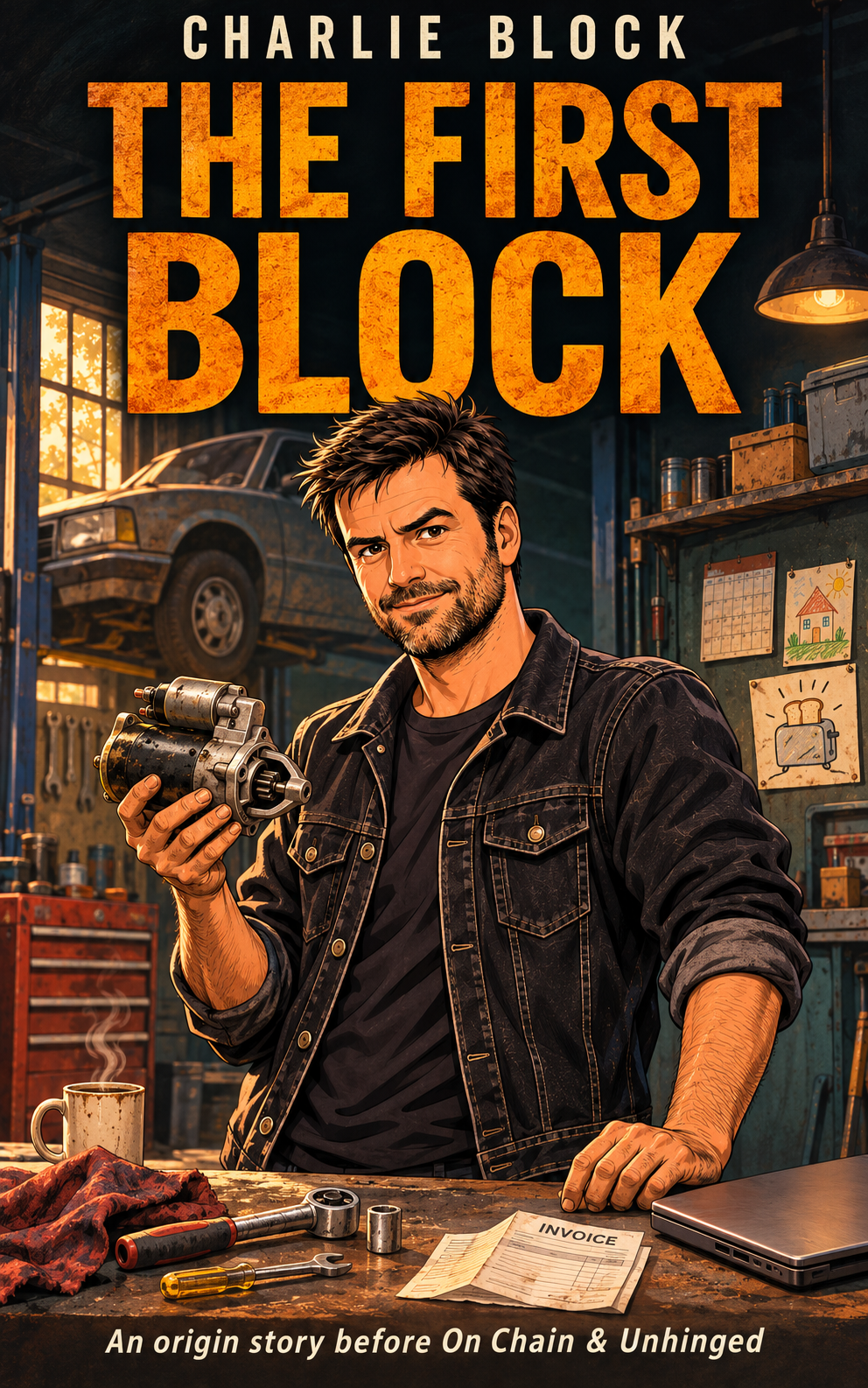
CHARLIE BLOCK
The First Block
An origin story before On Chain & Unhinged
by Charlie Block
Text copyright © 2025 by Charlie Block
All rights reserved.
This is a work of fiction. Names, characters, organizations, places, events and incidents are either products of the author’s imagination or are used fictitiously. Any resemblance to actual persons, living or dead, or actual events is purely coincidental.
No part of this book may be reproduced, stored in a retrieval system, or transmitted in any form or by any means, electronic, mechanical, photocopying, recording or otherwise, without express written permission of the author.
Please share the official free download link at OnChainCharlie.com rather than uploading copies elsewhere.
Charlie Block is a fictional character. No prior reading or knowledge of cryptocurrency is needed to start here.
Contents
Choose a section to start reading.
Before the first block
Long before Charlie Block had a bank account, he had a delivery business. It lasted until his father finished inspecting his coffee.
The toast came out of the toaster fast enough to clear the counter. It crossed the kitchen in a neat little arc and landed corner-first in the mug beside the newspaper.
Coffee climbed the rim. The newspaper acquired a brown coastline.
His father looked at the mug. Then at the toaster. Then, very slowly, at Charlie.
Charlie stood beside the counter, trying to look like the result had matched his calculations.
“Breakfast delivery.”
His father said nothing.
Charlie waited a beat, then held out his hand.
“Delivery’s extra.”
His father looked down at the hand. The toast sank.
There had been nothing wrong with the toaster before Charlie improved it. That was the difficulty with leaving things alone. Perfectly working things never explained how they worked.
Later, when the cover came off and a sharp spark turned the kitchen lights out, his father found him by the window, still holding the cover.
“Unplug it before you open it, Charlie. And get me first.”
Charlie looked at the dark ceiling light. His father looked at the coffee.
“That’s coming out of your delivery fee.”
Charlie checked his empty hand.
The years that followed gave him plenty of practice with machines and rather less practice leaving them alone. He liked finding the useful thing inside a broken one. He liked it even better when somebody would pay for it.
By seventeen, he had moved on to machines that wouldn’t fit on a kitchen counter. His father’s coffee had become considerably safer.
Chapter 1: Scrapyard Hustle
1999–2001
The yard boss had written DEAD on the starter in yellow paint. Charlie held it up by the mounting bracket.
“How dead?”
“Fifteen dollars dead.”
Charlie turned it over. The casing was sound. The terminals needed cleaning, and he wanted to look at the contacts before believing the paint.
“Ten.”
The boss looked at him over his coffee. “Want me to bury it too?”
Charlie paid fifteen.
He had been picking through wrecks since he was seventeen. A whole car could be worth less than the useful parts somebody had stopped looking for. The trouble was finding those parts before a man with a forklift turned them into something flatter.
This starter had come off an ’87 Monte Carlo. Charlie checked the part number, carried it into the workshop and cleared a space on the bench. By the time the boss came through again, the worn contacts were beside it and Charlie had the replacement he needed.
“You fixing that?”
“I’m trying to improve its attitude.”
He cleaned it, replaced the damaged parts and took it to the shop’s test bench. On the second run, the motor spun cleanly. He tested it again, then photographed the part number and wrote down what he had replaced.
His eBay listing said REBUILT AND TESTED. He did not include a photograph of DEAD.
The buyer turned up two days later in a car his wife had lent him. He compared Charlie’s starter with the old one in his trunk, checked the number twice and watched the test.
“Eighty-five?”
“That’s what the listing says.”
“My brother says you got it out of a junkyard.”
“I did.”
“Should be cheaper, then.”
Charlie pointed to the old starter. “Yours is free. It just won’t start your car.”
The man looked at it, then laughed and counted out the money.
Charlie put the worn contacts in a small bag and included them with the receipt. The buyer asked why.
“So you know what was wrong.”
“My wife’s going to want those.”
“She fixing the car?”
“No. Proving I should’ve listened to her.”
The yard boss watched the car leave. Charlie was still folding the cash when the old man came over.
“Eighty-five dollars for my dead starter?”
“For a working one.”
The boss grunted. That afternoon the box of dead starters beside the workshop acquired a new sign.
FORTY EACH.
Charlie stared at it.
“They were fifteen this morning.”
“You’ve been teaching me about potential.”
Charlie reached for the one he had already picked out. The boss put a hand on the box.
“Forty.”
Charlie put it back. Around the corner, behind a stack of doors, there was a pallet the old man hadn’t looked at in months. He went to see what was on it.
By nineteen, he was buying whole junkers and selling the usable parts. The money went toward a place where somebody else couldn’t change the price of his next job just because he had done the last one well.
He kept a folder of shipping labels, receipts and photographs. On the front, in black marker, he had written SHOP.
Underneath, much smaller: My prices.
Chapter 2: The American Dream
2005
The sign above the shop read Block Auto Sales, but most people just called it “Charlie’s place.”
Two garage bays, a gravel lot full of beat-up used cars and an office that smelled of burnt coffee. Years of seized bolts, late collections and buyers asking whether an alternator would fit a completely different car had paid for the down payment.
The bank covered the rest. He hated the idea of debt, but he was twenty-three and believed momentum was more important than fear.
He also had Samantha, Jake and Luna to think about. The shop was supposed to buy them something his side jobs never could: a future that didn’t depend on how many hours his back would hold up.
“Morning, boss,” said Manny, his first hire. Ex-con, great with suspensions.
Charlie nodded, coffee in hand, already checking his clipboard. They had five appointments booked, two trade-ins to assess, and a Honda Civic that needed a new catalytic converter before noon.
The work didn’t stop just because the title on the door changed. Charlie liked it that way.
He still got under the hoods, stayed late and dealt with buyers who treated every price as the opening of a hostage negotiation. But now it was his name on the invoices.
The dealership wasn’t flashy, but it was profitable. Charlie had built a reputation for selling decent cars to broke people and standing behind what he sold. If something went wrong, he made it right. That’s why they kept coming back.
Charlie put a FREE COFFEE sign beside the office door. By ten, a man from the tire shop had filled a travel mug and was asking whether they had lids.
“You looking for a car?” Charlie asked.
“No. Coffee.”
“The sign’s meant for customers.”
The man pointed at his mug. “I’m trying.”
Manny watched him leave. “You’ve got a repeat customer.”
“He hasn’t bought anything.”
“Keeps coming back, though.”
Samantha arrived with lunch as Charlie was taking the sign down. She read it, found his marker and added FIRST CUP.
“I was going to put that,” Charlie said.
“I know. You were waiting for the second pot.”
The lunch was in a paper sack. Jake insisted on carrying the drinks. Luna carried a drawing of the shop, complete with a purple car and a sun bigger than the building.
Charlie taped it above the desk where customers could see it.
“Your inventory needs work,” Samantha said, looking at the purple car.
“Custom paint. Costs extra.”
Luna put both hands on his knees and told him which window was his. He listened while his sandwich went cold. When a customer pulled into the lot, he let Manny get the keys.
And now, for the first time in his life, Charlie was thinking long-term. He was setting aside money for expansion. Maybe a second lot. He’d been reading about inventory software and ways to keep customers coming back. Even took a night course on selling online.
He didn’t know where things were headed, but for once, he didn’t feel behind.
If the numbers held, he could quit taking Sunday repairs. Be home for a whole weekend without counting what it cost him.
Chapter 3: The Collapse
2008
The first sign was subtle. A couple who’d been approved for financing the week before called to back out. The wife had lost her job. The husband was “re-evaluating their needs.” Charlie told them no problem, hung up, and stared at the blank line on the sales ledger for way too long.
The second sign wasn’t subtle at all. The bank cut the credit line he used to buy cars for the lot. The letter gave him a deadline to pay down the amount above the new limit.
The arrangement had seemed simple. The bank financed his inventory. When a car sold, he paid back the money tied to that car. Now buyers were disappearing, and the bank wanted money he could only get by selling the cars.
He called the number on the letter. A woman took him through the clause in his agreement that allowed the bank to reduce the line.
Charlie found his signature at the bottom. It was still his. That made the explanation worse.
By October, half the cars on his lot were sun-faded from sitting too long. No buyers. No loans. People who used to stop and look now drove past in the cars he had hoped they would replace.
Charlie tried discounts, trade-ins and a local radio spot. Manny heard the advert on his way in.
“You sound confident.”
“They charged extra for desperate.”
They sold one car that week. Its buyer needed the bank to approve the loan. The bank said no.
He stopped paying himself first. Then he fell behind on Manny’s wages. Then he stopped opening the bills.
Manny kept a record of what he was owed. Charlie couldn’t bring himself to look at it.
He knew it was over the night his power got shut off mid-oil change. He finished the job by flashlight, handed the keys back to a stunned customer, and locked the doors behind him.
For the next two evenings he stayed after the last customer had gone, sitting on the cold garage floor between unsold cars. At home, Samantha kept his dinner warm until she gave up.
Eventually, he called the guy who’d made him the offer months ago. The one he’d laughed off.
A competitor. A shark.
They shook hands in the office Charlie had poured himself into. Every shelf, every bolt, every hour stolen from sleep.
The sale would settle the business debts, including Manny’s pay. Charlie would stay on as head mechanic.
No ownership. No say. Just a job. Before he left, he took Luna’s drawing off the wall. The tape tore one corner. He folded it carefully anyway.
He told himself it was temporary. That he’d rebuild. That the world would bounce back and so would he.
He had understood every repair on the lot. None of them explained why a business that had worked last year could stop working while he was still doing the same jobs.
The bank’s letter stayed in his jacket pocket long after the sale.
Chapter 4: A New Reality
2010
Charlie still opened the garage before sunrise. He still knew which bay door needed a shoulder against it. But his name was off the paperwork, and now he had to ask somebody else before ordering a part.
Even the coffee machine had changed. New, sleek and producing exactly the same burnt coffee. Somebody had paid extra for that.
“You hear about this Bitcoin crap?”
Greg Fiat stood beside the pot, squinting at his laptop.
“Idiots think they can make their own currency. No bank. Just computer guys playing pretend.”
Charlie reached for a clean mug. “Sounds like your kind of thing.”
“Hell no. One EMP blast and poof. Life savings gone.”
“What happens to the coffee?”
Greg looked at the machine.
“Might be an improvement,” Charlie said.
Greg went back to the article. “My cousin’s mining it. He couldn’t set the clock on his microwave.”
Charlie took his mug to the Impala waiting in his bay. It had a cracked radiator and a customer who thought topping it up
counted as maintenance. By lunch, he had found the leak. Greg had found a forum post about stolen Bitcoin and was waving it like a repair estimate.
“See? Gone. No refunds. No customer service.”
“What broke?” Charlie asked.
“The Bitcoin.”
“All of it?”
“Somebody got into the guy’s computer. Took his wallet file.”
Charlie put down the hose. “Then why are you blaming the money?”
“Because he hasn’t got it.”
That night Charlie opened bitcoin.org on his laptop, using the shop’s wireless connection from his truck. He understood perhaps one sentence in five. The sentence about payments without a financial institution in the middle held him longest.
He still had the bank’s letter in his jacket. He took it out, read the deadline that no longer mattered and put it back.
Then he found Greg’s forum post. The replies argued about a stolen file, an infected computer and whether any of it had happened. By the bottom of the thread, three people had been called idiots. The coins were still missing.
He wrote two questions on an envelope: What failed? Who could fix it?
The envelope was a bill. He had been using it as scrap paper for a week.
At home Samantha asked what had kept him.
“Reading something.”
“Anything good?”
“I haven’t got to that part.”
Chapter 5: Almost
2011–2012
Forty dollars would buy more than thirty coins. Charlie checked the figure on the exchange page, then counted the money in his wallet.
The site looked unfinished. Funding an account meant following instructions, waiting for a transfer and trusting names he couldn’t connect to faces. He had once driven forty miles to collect a transmission from a man who turned out to be selling a photograph of one. The photograph had been excellent.
He closed the laptop.
On the drive home he remembered the milk on Samantha’s list. He bought it, carried the change inside and left it beside the receipts on the kitchen table.
The next evening he picked up a cash repair. Then another. If he couldn’t decide what to do with Bitcoin, he could at least earn money while thinking about it.
Craigslist jobs, rebuilt alternators, a junker he could turn around on his own time. He kept the profit in a parts box beneath the basement stairs. At first it was for another shop. He wrote down the cost of renting a bay, then insurance, then the deposit on the electricity.
The bottom of the page looked very much like the life he already had.
On the next page he wrote what the same money could buy in Bitcoin.
He left both plans open.
One Sunday Jake brought down a bicycle wheel that wouldn’t turn straight. Charlie moved the laptop aside and found the bent spoke.
“Can you fix it?”
“You can.”
Jake looked at the wheel. “I was hoping for the other answer.”
Charlie showed him where to start. A job he could have finished in ten minutes took them most of the afternoon. Jake adjusted it, spun it, made it worse and asked whether they could just buy another wheel.
“With whose money?” Charlie asked.
Jake thought about that and picked up the tool again.
When the wheel finally ran true, he pushed the bicycle through the kitchen as though they had invented transport. Samantha made them take it outside before demonstrating it around the table.
“How much do I owe you?” Jake asked.
“An afternoon.”
“Already paid.”
Charlie laughed. After dinner he went down to put the tools away. The shop figures were still on the screen. He added another column for what he could earn in a year of weekends.
The box would fill. He just wished it would fill faster.
Chapter 6: Side Hustles and Secrets
2012
During the day, he was the reliable mechanic. Early to work, late to leave, grease under his nails, coffee in his veins.
At night came Craigslist repairs and junker flips. One buyer paid for an alternator in silver coins. Charlie checked what a dealer would give him before agreeing.
“You don’t trust silver?” the man asked.
“I trust it to be silver. The electric company wants dollars.”
The stash was growing slowly. Tucked in the same box beneath the basement stairs. By autumn it was close to four thousand dollars. Maybe more. A few more months, and he could finally make a move.
He hadn’t told Samantha the total. Every time he thought about showing her the box, he pictured her asking which bills they could clear with it.
She was already tired. Working weekends at the diner. Taking care of Jake and Luna between shifts, doing the bills when everybody else had gone to bed.
Then came the accident, on a cold afternoon in December.
A playground fall. Luna slipped from the monkey bars and landed wrong. One bad twist and a fractured wrist.
Charlie got the call while he was finishing a brake job. He handed Manny the tools without putting them away.
The emergency room took six hours, most of them spent waiting. Luna leaned against him with her good hand hooked in his sleeve. When he tried to shift, she tightened her grip.
He stayed where he was.
Samantha handled the forms and the insurance card. Jake sat beside her, quiet for once, turning an old magazine over without reading it.
The doctor showed them the X-ray and explained the break. Luna asked if she would still be able to draw. Charlie had been wondering whether she would need surgery. Hearing her question nearly broke him.
The cast that followed was pink. The staff were kind. At the desk, Samantha asked whether they needed to do anything else about the insurance.
“They have the information,” the woman said. “You’ll get the paperwork.”
Charlie heard that as settled. Luna was coming home, and the thing wrong with her could heal.
On the drive back, Luna fell asleep before they reached the main road. He turned down the radio.
He carried her inside without waking her. The bill could arrive later.
Chapter 7: The Rabbit Hole
Late 2012–February 2013
By January the box held six thousand dollars. Then his truck needed a water pump and hoses, and it held $5,721.
He had a Bitcoin page open most evenings now. Some posts were useful. Others promised that anybody still asking questions would be left behind. A man with a cartoon rocket for a face seemed especially certain.
Charlie printed a chart showing what a purchase might be worth at a million dollars. Under it he began a second calculation for zero. That one took considerably less paper.
Samantha found him at the kitchen table.
“Are you talking to your laptop?”
“It’s not answering.”
She sat beside him. “What are they selling?”
“A network. No bank in the middle.”
“All right. If you buy it, who pays you more for it?”
“Somebody who wants it later.”
“And if they don’t?”
Charlie looked at the rocket man’s latest post.
“He says we’re still early.”
“For what?”
He turned the laptop so she could see the explanation. She waited while he scrolled past an argument about a mining pool, two price predictions and an advertisement.
“I’m asking because it’s our money, Charlie.”
“I haven’t bought anything.”
“Then this should be a good time to talk.”
He began explaining the supply limit. She closed her notebook and went upstairs before he finished.
The following week he created an exchange account and wrote down the funding instructions. A hundred dollars, he decided. A test. The buying screen was ready. He wasn’t.
Upstairs, a floorboard creaked. Charlie put the notebook beneath the takeout menus. The menu on top offered a family meal for less than his proposed test. He turned it over.
Chapter 8: The Unexpected Bill
February 2013
The envelope arrived between a pizza menu and a promise that Charlie was preapproved for more debt.
He opened it after dinner.
$8,732.91.
Luna’s December emergency room visit. The pink cast was already off, but one doctor had been out-of-network. Charlie followed the hospital charges, physician charges and allowed amounts until he reached the same balance again.
The insurance explanation said THIS IS NOT A BILL. The other piece of paper appeared determined to make up for it.
“What’s wrong?” Samantha asked from the doorway.
He folded the statement.
“Shop invoice.”
“Something I can help with?”
“I’ve got it.”
He hadn’t even found the number to call.
Over the next few evenings he waited on hold, sent an appeal and kept the letter in his pocket. Between calls he set up an empty Bitcoin wallet. That job had instructions he could finish.
The software gave him recovery words. He wrote them out, checked them and tried restoring the empty wallet. The same
address came back. He made a second copy and hid both in the garage, one behind the socket set and one above the ceiling.
The wallet contained nothing. He had protected that nothing extremely carefully.
The dryer had stopped before he noticed how long he had been out there. He climbed down, put the envelope behind the sockets and dialed the insurer again.
Chapter 9: The Last Move
February 21, 2013
Charlie balanced the shop’s cordless phone between his shoulder and ear while fitting a wheel to a rusty Ford Ranger. Tinny hold music bounced around the concrete bay.
“Your estimated wait time is forty-five minutes.”
Second pot of coffee. Third call that week. Same song.
He set the phone on the bench and finished tightening the wheel with both hands.
When the line finally clicked, a tired voice said, “ClearCross Health Claims. This is Deena.”
“I’m following up on my daughter’s emergency room visit in December.”
He gave the claim number. Keys clicked somewhere far away.
“The attending physician was out-of-network.”
“He was the doctor they brought us.”
“You can appeal the determination. I can send the form.”
“You already sent the form. I sent it back.”
Another pause. “Review can take six to eight weeks.”
Charlie unfolded the notice he had collected from his home mailbox that morning. “The final notice says February twenty-sixth. That’s five days.”
“You’ll need to speak to the provider about the payment deadline.”
He asked for a supervisor. The music returned.
Manny leaned around the fender. “Still them?”
“If they make me fax one more form, I’m faxing them my middle finger.”
“Make two copies. They’ll lose the first.”
Charlie laughed once, without much feeling. Then he hung up and called Pioneer Ridge Medical Center’s billing office.
The representative confirmed the balance. She could discuss three monthly payments. There was also an assistance application, though she couldn’t promise approval or a decision before the notice date.
Three payments of $2,910.97. Charlie wrote the amount on the back of an oil filter carton. The first payment was possible. The next two would eat months of work he had already spent in his head.
“Is there a co-applicant or another household income?” she asked.
He stared at the question as if it had appeared on the carton too.
“I’ll call back.”
He didn’t call Samantha. He opened a loan advertisement on his phone instead.
EZ-ADVANCE. CASH TODAY. 29.99% ANNUAL PERCENTAGE RATE.
Three thousand dollars, almost thirty percent. The application took less time than the hold queue.
That evening he carried the parts box into the garage and counted $5,721. The lender’s three thousand would still leave him $11.91 short. He found it in the change jar above the dryer, separating the pennies with a screwdriver.
Luna’s discarded pink cast sat upstairs in a shoebox. Everybody had signed it except him. He had kept saying his hands were too dirty.
At the loan office he read the repayment schedule: first payment March 25, almost thirty percent interest. The clerk waited while he read the total again.
He could still call billing again. Wait for the appeal. Sit down with Samantha and explain the box. Instead he asked the clerk for a pen.
He signed.
Chapter 10: Pressure Valve
February 22, 2013
Samantha found the loan paperwork while emptying Charlie’s work trousers before a wash. The folded copy had gone soft at the corners.
Three thousand dollars. Almost thirty percent interest. First payment due March 25.
She checked their joint account. No matching deposit. No hospital payment. She put the papers beside the cutting board and finished slicing the bell peppers.
Charlie came in smelling of hot oil and the orange soap that never quite removed it. He kissed her cheek and reached for the tap.
“What’s EZ-Advance?” she asked.
The water ran a little too long.
“A short-term thing. Parts order for Manny. He’ll pay me back.”
“You borrowed three thousand dollars for somebody else’s parts?”
“It sounds worse than it is.”
She laid the repayment schedule flat. “Does Manny know what it costs?”
“I won’t keep it that long.”
“That wasn’t my question.”
Jake called from the living room before Charlie had to answer. “Dad, what’s a hash rate?”
Charlie turned too quickly. “Where’d you hear that?”
“A guy’s building a Litecoin miner out of an old computer. I think we have most of the parts.”
“Homework first.”
“It is homework. Practically.”
Luna appeared holding the shoebox with her cast. At eleven, she was old enough to hate being fussed over and young enough to want everybody’s signature where she could keep it.
“You never signed this.”
Charlie took the marker from her. His hands were clean now. He wrote Dad beside the thumb opening, then drew a tiny wrench. She inspected it.
“That looks like a spoon.”
“Emergency ice-cream tool.”
She inspected the spoon again, then smiled. Charlie drew a scoop beside it. Samantha left the marker on the table in case either of them wanted another turn.
Then he glanced at the loan papers.
After dinner she followed him to the laundry room. “What happened with the hospital?”
“Handled.”
“Paid?”
The envelope was ready on a shelf in the garage. He was going to pay it.
“Yes.”
Samantha watched him a moment longer. “Leave the receipt where I can find it.”
When he went out to the garage, Samantha entered the lender and due date in her green notebook. Underneath, she wrote: Hospital receipt.
* * *
February 23, 2013
Jake had laid his proposed mining rig across the garage floor. A battered computer case. An old graphics card. Cables that seemed to have multiplied since Charlie last looked.
“This one can do Litecoin,” Jake said. “The video says Bitcoin’s different now. You need better stuff.”
At thirteen, he could spend three hours finding the right driver and still forget a plate in his room until the fork stuck to it.
Charlie was working on a customer’s water pump. “What’s it going to cost?”
“We already own the computer.”
“What’s it going to cost to run?”
Jake glanced toward the outlet. “Electricity, I guess.”
“And the card?”
“We already own that too.”
“Who’s we?”
Jake gave him a patient look. “The family. You’re always saying that.”
“The family also owns a vacuum cleaner.”
“That doesn’t earn anything.”
“It might if you switched it on.”
Charlie put down the wrench. He had promised to help, and for once the work in front of him could wait ten minutes.
They checked the power supply label and cleared the rags from the bench. Jake explained the program, pointing at the screen when he lost his place. Charlie leaned closer.
“You should learn how it works before you put money into it,” Charlie said.
“That’s what I’m doing.”
Fair enough.
Jake pointed to the tutorial. The builder had put the motherboard in a gutted toaster shell.
“That’s not a toaster mining money. That’s a computer wearing a toaster.”
“Still cooler than a beige box.”
Charlie had to give him that.
For a while they worked together. Jake found the right connector. Charlie held a flashlight over the board. The water pump sat unfinished, and the laptop behind them stayed closed.
When Samantha called them in, Jake gathered the loose parts instead of leaving them where somebody would step on them.
“Tomorrow?” he asked.
“We’ll finish setting it up.”
Jake nodded as if it were a firm booking.
Charlie glanced at the hospital envelope, then went inside. Jake had saved him a chair.
Chapter 11: Deadlines
February 24, 2013
In the garage, Jake had left the computer open on the bench. Beside it was a scrap of cardboard: ASK DAD BEFORE SWITCHING ON.
Charlie had forgotten their appointment.
He moved the computer aside to make room for the laptop.
* * *
February 25, 2013
Charlie sat in the truck with the radio off and the hospital envelope on the passenger seat. Pioneer Ridge Medical Center. Payment due February 26, five o’clock.
One day left.
The cashier’s check was for $8,732.91. The teller had taken everything from the box, the loan and the change jar. Charlie had brought the fee separately.
Inside the billing office, the air smelled of toner and antiseptic. A woman behind a clear partition slid open a tray.
“Payment today?”
Charlie handed over the check.
“Full amount?”
He nodded.
She typed, waited, then printed a receipt. The whole thing took less time than he had spent on hold during any one of his calls.
At the door he checked the receipt. Right account. Full amount. Balance: zero. The first loan payment was still due next month. He folded the receipt and took it home; the appeal would have to continue after payment.
At home he placed the receipt beside Samantha’s notebook.
She read the date first.
“Today?”
“It’s paid.”
“You told me it was paid on Friday.”
Charlie opened his mouth, then closed it.
Samantha looked at the amount. “Where did the rest come from?”
“Side jobs.”
“How long?”
“A while.”
She sat down. He watched her assemble the months he had allowed her to think they had nothing to spare.
“You watched me take extra shifts.”
“That money was supposed to get us out.”
“I was already here, Charlie. So were they.”
She put the receipt with the loan agreement.
He went outside because he couldn’t think of an answer that wasn’t another defense.
Chapter 12: Credit Limit
February 26, 2013
Before work Charlie found the coming month’s bills on the kitchen table. Samantha had added the loan payment. He could see how many more evenings the gap would cost him.
At lunch, he sat in his truck and opened the credit card account on his phone. Two thousand dollars of available credit. A rate he should have found discouraging.
The card couldn’t have covered the hospital bill. Now its green available balance looked like a fresh start, though every dollar would be another debt.
Samantha received alerts on their shared account. If he used it, she would see.
For a moment he considered changing the alert settings.
His thumb stopped over the settings. He was planning how to hide the charge before he had worked out how to repay it.
He closed the account page.
That afternoon he accepted two weekend repair jobs. A brake job and a radiator replacement, both paid in cash after the owners bought the parts. Three hundred dollars for his labor if everything went to plan.
He wrote down the repair appointments, then Bitcoin on the next page.
* * *
Late February 2013
Samantha sat cross-legged on the bed, laptop balanced on her knees. Charlie was in the garage again.
Luna appeared in the doorway with a cup and the stuffed pig she claimed she only kept because it was old.
“Is Daddy mad at us?”
Samantha lowered the laptop.
“No. Why would you think that?”
Luna shrugged. “He never laughs anymore.”
Samantha took her to the kitchen for water.
“The bills have him worried,” she said. “That isn’t because of you.”
Luna looked at her wrist. There was a pale band where the cast had been.
“I didn’t mean to fall.”
“I know.” Samantha put her hand over Luna’s. “Nobody thinks you did.”
In the garage, Charlie posted under TorqueLite67. He hoped the name would keep Greg from finding his questions.
He typed: If I buy on an exchange, how do I know the coins have actually reached my own wallet?
The replies arrived quickly. Check the receiving address. Check the transaction. Don’t confuse the exchange’s number with your wallet’s balance.
One answer came from a user called VoltaireJones. There was a suited man in the profile picture, though Charlie had no way to know whose photograph it was.
Keep control of your keys. And think long-term. Bitcoin doesn’t care what you paid for it.
Charlie copied the first sentence into his notebook. He reread the second before going to bed.
Chapter 13: Echo Chamber
Early March 2013
“Customer’s waiting.”
Manny stood beside the lift. Charlie put his phone away and finished checking the brake lines. He had asked for two seconds several minutes ago.
That evening he followed a warning about an exchange delaying withdrawals. Four threads repeated it. All four led to the same anonymous screenshot.
He asked whether anyone had another source. A user accused him of spreading doubt. Another told him to read more. The screenshot disappeared when its owner deleted the account.
Charlie deleted his question. The next thread predicted a price he liked. He read that one to the end.
Samantha brought him tea.
“The appeal acknowledgment came,” she said. “They’ve got the paperwork. I’ll call next week.”
“You don’t have to.”
“I know.”
He noticed the small burn on her wrist from the diner.
“Busy shift?”
“Everybody wanted their food at once.”
“Unreasonable.”
“One man asked if the coffee was fresh.”
“Was it?”
“It had never been used.”
He smiled. She did too, briefly.
“The brake job and radiator came to three hundred,” he said.
“That covers the immediate gap.”
He hesitated.
“Charlie.”
He took the cash from his pocket and put it on the table beside her notebook.
“All of it,” he said.
She counted it without making a ceremony of it. He went back to the garage and pulled the old transmission out from under the bench. It had been sitting there for nearly a year. Somewhere, he hoped, a buyer still wanted one.
Chapter 14: The Window
Early March 2013
The buyer paid eight hundred and twenty dollars for the rebuilt transmission. Charlie showed him the connector clip that needed replacing and helped load it onto the truck.
“You didn’t have to tell me about that,” the man said.
“You’d have found it.”
“After I got home.”
“Then you’d have called.”
The buyer laughed and checked the straps. Charlie liked customers leaving with the right idea of what they had bought.
He was counting the cash in his pocket when a sharp pop came from the garage. The lights went out.
Jake stood beside his proposed miner with his hand frozen near the switch. An adapter lay against the side of the case. It had not looked like that yesterday.
“Don’t touch it.”
Charlie disconnected the power and checked the machine before resetting anything.
“The guy in the video said the supply was enough,” Jake said.
“For his computer.”
“It looked the same.”
Charlie put the damaged adapter on the bench. “We check what’s connected to it before switching it on.”
“You said you’d help.”
Charlie looked at the cardboard note beside it: ASK DAD BEFORE SWITCHING ON. He had told Jake to write that.
“I know. Get the manual.”
They spent the evening finding a suitable replacement supply. The following day they put the machine back together in its metal case. The shoebox of spare cables stayed on the floor, which was enough for Jake to keep calling it his shoebox miner.
When the screen finally showed accepted shares, he shouted so loudly Luna came running.
“Are you rich?”
“It means it’s working.”
“So, no.”
Jake ignored her and turned the screen toward Charlie.
“Good work,” Charlie said.
His son began explaining the setting he had corrected. Charlie’s phone vibrated. He left it in his pocket and asked Jake to show him again.
At dinner Jake announced that the computer would be earning money while he slept.
“Wonderful,” Samantha said. “It can have your Saturday shift with the dishes.”
“That’s not how mining works.”
“Neither is leaving a plate upstairs until we need to excavate it.”
Luna slid an empty jam jar across the table. She had taped MINING PROFITS to the side.
Jake turned it over. “There’s nothing in it.”
“It’s accurate.”
Charlie laughed. Samantha caught his eye over the jar.
After dinner he recorded the transmission sale in his notebook. Eight hundred and twenty dollars. He had earned it, and the customer had driven away pleased. That made the money feel different from the three hundred he had just put toward the bills.
He didn’t take the notebook upstairs to test that explanation.
Chapter 15: Fractures
Early March 2013
Luna went with Samantha to buy the eggs Charlie had forgotten. In the passenger seat, she turned the radio down.
“Is Bitcoin bad?”
Samantha kept her eyes on the road. “I don’t know enough about it to tell you that.”
“Then why are you mad?”
“Because your dad keeps making decisions that affect all of us without telling me.”
Luna thought about that. “If it makes money, will you stop being mad?”
They were waiting at a red light. Samantha looked at her daughter.
“Making money wouldn’t make the lying disappear.”
Luna turned the radio up again, but only a little.
* * *
Early March 2013
Charlie’s first cryptocurrency purchase wasn’t Bitcoin.
It was twenty dollars’ worth of Litecoin, including the fee. He bought a small amount through a service he had been comparing with the one Jake used to track mining payouts. Then he withdrew it to a separate wallet that supported Litecoin.
He checked the receiving address and waited for confirmation. When the funds arrived, he closed the service’s website. His wallet still showed the balance.
Twenty dollars had become a balance under keys he controlled. It could be worth less tomorrow. For the moment he was pleased it had arrived at all.
Jake found him smiling at the screen.
“You bought some?”
Charlie hesitated, then nodded.
“How much?”
“A test. Twenty.”
Jake pulled up a chair. Charlie showed him the receiving address, then moved the envelope for his empty Bitcoin wallet out of sight when his son reached for it.
“Those words stay private.”
“I know.”
Jake pulled his chair closer, keeping his hands clear of the envelope.
Charlie entered the twenty dollars against the transmission sale. Eight hundred left. He would have to tell Samantha.
Chapter 16: Off Ramp
Early March 2013
Samantha’s phone buzzed with a message from someone she had served with years earlier. There was a civilian office opening near the old post. Better hours than the diner, perhaps. Would she like the details?
She asked how to apply and marked the deadline in green. Regular hours would give her weekends with the kids.
For a moment the message took her back to Fort Campbell, before the dealership and the stack of bills now spread across the table.
Charlie had been doing maintenance work for a civilian contractor. One lunch break he had sat down opposite her, grease beneath his nails, holding a tray of food he had already begun criticizing.
“You look like someone who reads contracts before signing them,” he said.
She didn’t look up. “You look like someone who doesn’t read anything.”
He laughed. “Got me this far.”
“This far being?”
“Fixing generators so the brass can yell at people on time. They feed me in hash browns.”
She had tried not to smile. He had offered her his last pack of gum. She let him hold it out a little longer than necessary before taking it.
She printed the application and set it beside her notebook.
Charlie came in with the receipt for his Litecoin purchase.
“Twenty dollars. From the transmission money. Including the fee.”
Samantha read it, then moved the notebook so he could reach it.
“Put it with the others. I need the numbers where I can use them.”
He wrote down the amount and the cash remaining. She clipped the receipt to the page, then went back to the job application.
Chapter 17: Signals
Early March 2013
Jake showed his mining figures to a boy on the school bus. The boy asked how much they were worth. Jake enlarged the number on the screen.
At home Luna helped record his explanation. She made him start again when he used a word he couldn’t explain.
“They can look it up.”
“Or watch somebody else.”
Charlie stopped in the doorway long enough to ask about electricity. Jake said they were going to measure it. They had said that before.
“We’ll use the meter Saturday,” Charlie said.
Jake wrote it on the cardboard beside his computer before Charlie could leave.
Luna edited the recording and played it back.
“You cut out all the bits where I asked questions,” Jake said.
“I left the bits where you answered them.”
“Makes me look like an expert.”
Luna held out her hand. “That’ll be extra.”
Charlie was still smiling when he left the room. He had six hundred dollars of the transmission money in his pocket, two hundred left at home and a meeting with a forum seller who called himself CashByCar.
The seller had offered Bitcoin for cash near a coffee shop. Charlie chose daylight and a place with people around. He bought the cheapest coffee and waited.
After twenty minutes, a message arrived.
Running late. Send fifty to reserve the coins. I’ll take it off the total.
Charlie typed: I’m here. You bring the coins. I bring the money.
The reply came quickly.
Price is moving. Your loss.
He looked at the cooling cup. So far the only guaranteed loss was the coffee.
He waited ten more minutes, then drove home with all six hundred dollars. He had told Samantha he was collecting a part.
The exchange account had a company address and a support page. After the parking lot, a website promising to answer questions felt almost respectable.
Chapter 18: Margin Call
Early March 2013
The pawn-shop man offered a hundred dollars for Charlie’s diagnostic scanner.
“It works.”
“I didn’t say it didn’t.”
“Then what’s wrong with it?”
“I’ve got to sell it to somebody who thinks it’s worth more.”
Charlie looked at him. The man looked back, untroubled by having described a business model Charlie understood perfectly.
They settled at $146. He had left the torque wrench and meter at home. He still needed them for jobs. The shop had a better scanner, he told himself, though the space in his old case bothered him on the drive back.
Samantha was at the kitchen table when he came in.
“I moved two hundred into the account in my name. Groceries and the school payment. I wrote it here.”
The joint account had held $271.44. She had left enough for the charges they expected before payday.
That evening Charlie added the scanner money to the eight hundred left after the Litecoin test, plus the change in his pocket. He had $946.78. He transferred a hundred to the exchange and wrote down the cash remaining before opening the buying screen.
He found two posts on the best time to buy. They disagreed. Forty minutes passed.
Jake balanced his phone on a toolbox.
“Welcome back to BlockChain Basics. Today we’re talking to my dad. What’s the secret to knowing when to buy?”
Charlie kept his eyes on the screen. “Not now.”
“One question.”
“I said not now.”
Jake stopped recording and took the phone inside.
Only after Jake left did he find an answer he could have given: he didn’t know.
He shut the advice tabs and went upstairs.
“I’m sorry I snapped.”
“Okay.”
“We can do it another time.”
“It doesn’t matter.”
Charlie stayed outside the door until it became clear that it did.
Chapter 19: Cold Storage
Early March 2013
The following evening Charlie bought a hundred dollars’ worth of Bitcoin, trading fee included. A small balance appeared beside his username.
He opened the withdrawal page and copied the address from the wallet he had backed up. There was another fee. If he moved the coins now, then sold, he would have to move them back.
He checked the chart. Morning would do.
Before bed he checked his recovery envelope against the copy above the garage ceiling. Everything matched. Nothing in those words protected the balance still sitting with the exchange.
At breakfast Jake asked if it was up.
“A bit.”
Samantha put down the coffee pot. “How much did you put in?”
“A hundred. From the things I sold.”
She looked at him. He had finally volunteered an amount, after spending it.
At 10:42 he tried to load the account during a break at work. The page didn’t open. Neither did it open on his phone. The forum filled with reports of an investigation. Then a seizure notice replaced the login screen.
Customer access suspended. No withdrawals.
Charlie called the support number. A recording told him to visit the website.
He opened his own wallet.
Zero.
He checked the receiving address, then the transaction list. There was nothing to find. He had bought a balance from a company and never completed the withdrawal.
His recovery words were intact. They could restore the empty wallet as often as he liked.
Manny found him beside the bench.
“Bad news?”
Charlie turned the phone over.
“I knew better.”
“Yeah,” Manny said. “That’s usually the expensive kind.”
The rest of his cash and the Litecoin were safe. He had lost a hundred dollars by ignoring advice he had written down himself.
At home Samantha found him taking the envelope down from the ceiling.
“What happened?”
He almost said supplier problem.
“The exchange is shut. I can’t get the hundred back.”
“Was that all you sent?”
“Yes.”
He showed her the transfer and counted the remaining cash. $846.78. She checked the page rather than relying on his tone.
“What are you going to do?”
Charlie saved the account records to a drive. He put the transfer receipt in the notebook.
“Start with what actually happened.”
She stayed beside him for a moment before going to check on the kids.
Epilogue: The First Block
Three evenings later, Charlie bought twenty-five dollars’ worth through a different service and withdrew it immediately.
He checked the receiving address twice. When a transaction appeared and later gained a confirmation, he closed the seller’s website and opened his wallet again.
Still there.
He leaned back so hard the chair complained.
“You fixed it?” Jake asked from the doorway.
“This part.”
Charlie showed him the new entry beside the record of the failed purchase.
“So what was wrong with the first one?”
“I paid somebody. Never collected what I bought.”
“Like leaving a gearbox at the seller’s house?”
“A seller whose house has disappeared.”
“Should’ve charged delivery.”
Charlie laughed. Jake smiled, surprised by how easily it had happened.
On Saturday they plugged the miner into the power meter. Jake read out what it had earned. Charlie worked out the running cost. They checked the figures twice, which did not improve them.
Luna fetched the empty profits jar.
“We’re reinvesting,” Jake told her.
“In the electric company,” Charlie said.
“Is that better?”
“They seem to be getting paid.”
Samantha called them to dinner. This time Charlie went up with the kids.
Afterward they worked through the bills at the kitchen table. He brought in the cash left after the twenty-five-dollar test. Eight hundred went toward coming payments. The last $21.78 went into the grocery envelope.
Samantha clipped an interview appointment to the back of her notebook.
“The office job?” he asked.
She nodded.
“What day?”
He moved a brake job so he could be home when the kids got back. She checked that he had actually written it down.
Luna put a drawing of their old shop on the table. A purple car occupied both bays.
“That customer’s paying for two spaces,” Charlie said.
“It’s your car.”
“Then I’d like a discount.”
“You always do.”
Samantha laughed into her tea. Charlie taped the drawing beside the fridge.
By payday he had sold both tiny crypto positions and put what came back toward the bills. His drawer was empty. The wallet was empty. For a few days, all the family’s numbers were in one place.
At work a customer asked to speak to the owner. Charlie had already started answering before he caught himself.
Then the price rose again.
Charlie looked at the cash he would have made on twenty-five dollars. It would barely have changed the grocery envelope. He entered a thousand instead. Then five thousand.
He knew he was giving yesterday’s rise to money he hadn’t risked. He did it again anyway.
Late that night Samantha came down for water. He was at the table with a page of figures.
“Still working?”
“Trying to get us a little breathing room.”
She rested a hand on his shoulder. “The bills are covered. Come to bed.”
He looked at the word SHOP on the old folder beside his elbow. Almost every dollar he had ever made had passed through his hands and gone to somebody else. Another year of weekends would fill another box. Another bill could empty it.
“In a minute.”
She waited, then took her glass upstairs.
The credit-card account showed two thousand available. It wasn’t enough for the number on his page. He opened a second tab and searched for borrowing against a car.
Samantha’s car was paid for. It started in the cold. It got her to the diner, the kids to appointments and the groceries home. She called it the one thing that never needed an explanation.
The form called it an asset.
Charlie entered the details. He had not borrowed anything yet. He could still stop. He could go upstairs and tell her why her keys were beside his notebook.
His phone lit up.
Samantha: Don’t forget we need milk in the morning.
He typed: I’ve got it.
Then he clicked Submit.
He had promised her milk. He had just offered somebody her car.
What Charlie does next
Charlie wanted enough money to stop worrying. In On Chain & Unhinged, he makes the bigger bet. For a while, it works. Then the money starts telling him he’s a genius.
Follow him from the kitchen table into bigger risks, a crypto fortune and consequences his family can’t simply log out of. A faster, darker and more outrageous story, told in Charlie’s own voice.
Read On Chain & Unhinged on Amazon
A taste of On Chain and Unhinged
A glimpse ahead from Chapter 2, The Crypto Houdini Act. Several years later, Charlie tells the story of the night his crypto success comes apart.
I always thought rock bottom would look different.
Maybe a foreclosure notice. Maybe a hospital bill I couldn’t pay.
Not this. Not a 130-foot yacht, overflowing with influencers, crypto hustlers, and enough champagne to impress Gatsby himself.
The FBI raid didn’t feel real until I saw a crypto bro trip over a champagne bottle and faceplant into the yacht’s deck. That’s when it hit me—this wasn’t a joke. This was the end of the line.
Chaos erupted instantly.
— Champagne towers crashed to the floor.
— Crypto bros scrambled like rats off a sinking ship.
— Someone screamed, “It’s the SEC!”—which somehow caused even more panic.
— Influencers live-streamed their own arrests, one of them shouting, “Smash that like button!” as he was cuffed.
— A desperate trader tried to send his Bitcoin to a cold wallet mid-arrest.
— And, of course, some guy in a neon “HODL” shirt actually tried to bribe an agent with an NFT titled “Diamond Hands Gorilla #42069.”
The agent just stared at him like he had offered a Monopoly Get Out of Jail Free card.
In the middle of it all, I just stood there, champagne glass in hand, watching my empire crumble.
How did I escape? Good question. I’ve replayed it so many times in my mind that even I’m not sure.
Continue Charlie’s story in On Chain & Unhinged.
Glossary of Crypto Terms
Altcoin.
A cryptocurrency other than Bitcoin. Litecoin is one example.
Bitcoin.
A digital currency and payment network introduced in 2009. Its public record lets participants check transactions without one bank maintaining the account book for everyone.
Blockchain.
A record built from linked groups of transactions called blocks. In Bitcoin, network participants check this shared record against the system’s rules. A blockchain does not, by itself, make every business using it honest.
Cold storage.
Keeping the keys that authorize cryptocurrency spending offline. The coins are recorded on the blockchain, not stored inside a piece of paper or a device. Charlie’s hidden recovery cards do not make his internet-connected wallet cold storage.
Confirmation.
A transaction receives a confirmation when it is included in a block. More blocks built after that block add confirmations. Seeing a pending transaction is different from seeing a confirmed one.
Cryptocurrency.
Digital money whose ownership and transfers are governed by cryptographic rules. Different cryptocurrencies can work in different ways.
Custody.
Responsibility for holding or controlling an asset. On an exchange, the company commonly controls the keys and keeps a record of what it owes its customers. With self-custody, the user controls the keys and must protect them.
Exchange.
A service for buying, selling or trading cryptocurrencies. An account balance at an exchange is not the same as cryptocurrency already withdrawn to a wallet the customer controls.
Fiat money.
Money, such as modern dollars, that is not redeemable for a fixed quantity of gold or another commodity.
FUD.
Short for fear, uncertainty and doubt. People use the term to dismiss negative claims or describe attempts to frighten others. Calling something FUD does not establish whether it is false.
Handle.
A name used on a forum or other online service. A familiar name and photograph do not establish who is behind an account.
Hash rate.
The rate at which mining equipment performs hash calculations. It helps describe mining capacity, but it does not tell you the profit after electricity, equipment and other costs.
Litecoin.
A cryptocurrency launched in 2011. It has its own network and transaction record, separate from Bitcoin’s. A Litecoin transfer must use a compatible Litecoin wallet and address.
Mining.
In systems such as Bitcoin and Litecoin, miners compete using computing power to propose new blocks. Valid blocks can earn rewards and transaction fees. Running a machine does not guarantee a profit.
Mining pool.
A group that combines miners’ work and distributes rewards under its own rules. A pool may count smaller pieces of work called shares. An accepted share is not a whole coin, and a pool balance is not yet a payment to a personal wallet.
Off-chain.
Outside the blockchain’s transaction record. A trade shown only in an exchange’s own customer accounts can be off-chain.
On-chain.
Recorded on the blockchain. A company changing a number on its website does not necessarily mean an on-chain transfer has occurred.
Private key.
Secret information used to authorize spending cryptocurrency. A wallet password can protect access to that information, but the password and private key are not the same thing.
Recovery phrase.
A set of words used by certain wallets to back up the information needed to restore them. It is also called a seed phrase. The words must be used with compatible wallet software. Losing the only usable backup and access to the original wallet can make funds unrecoverable.
Wallet.
Software or a device used to manage the keys and addresses involved in receiving and spending cryptocurrency. A wallet can show a balance because it reads the relevant transaction record; it is not a container full of digital coins.
Withdrawal.
Moving funds out of an account or service. In Charlie’s case, buying Bitcoin on an exchange and withdrawing it to his own wallet are two separate actions.
A note from the author
If you met Charlie in The Block Bunch cartoons, the kitchen may look familiar. The opening adapts Breakfast Delivery and Unplug First. This story follows him beyond those childhood mishaps, into work, family and the temptation to find a shortcut.
You don’t need to watch the cartoons or understand cryptocurrency to start here. Nor do you need to agree with Charlie. Some of the pressure on him is unfair. Some of the damage is his doing.
Thank you for giving Charlie a chance.
Charlie Block
More Charlie at OnChainCharlie
Start wherever you like. You don’t need to follow a viewing order or finish a book before watching a short.
The Block Bunch
Short, standalone comedies about Charlie’s curiosity and the consequences. Follow his next bad idea at OnChainCharlie.com.
Charlie’s Money Files
Charlie investigates money, banking and the history behind the systems we use. These evidence-led videos are separate from his fictional adventures.
Real experiences
Personal accounts from the creator’s life are also planned. They will be identified separately from Charlie’s fiction. Find available videos and updates at OnChainCharlie.com.
Prefer your browser's PDF viewer? Open the PDF in a separate tab or use the download button above. This reader uses the same approved text with paragraphs that adjust to your screen.
We count reader opens and download clicks separately. Opening the reader does not tell us how much you've read. Privacy details